
Auburn DVM student connects family story to veterinary history
When Auburn University DVM student Carrie Elaine Smith needed a topic for the American Veterinary Medical History Society’s annual essay contest, she found inspiration within her family. Growing up, she had heard stories from her grandfather about a champion Thoroughbred named Bold Ruler coming to Auburn University’s College of Veterinary Medicine in 1970 for a medical moonshot of sorts.
So when it came time to submit an entry for the society’s 2026 Smithcors Student Veterinary History Essay Contest, those memories led Smith to Auburn University library resources and, more importantly, her grandfather.
“It was really fun to look into the details of it because he’s older now,” said Smith, who placed fourth in the national essay contest for her submission, “Bold Ruler: The Yardstick of Radiation Oncology.”
In her essay, Smith explored a landmark case study for large animal veterinarians. A cancerous tumor deep inside Bold Ruler’s nasal passages made it difficult for him to breathe. Since the tumor could not be surgically removed, Auburn’s veterinary team turned to experimental cobalt-60 radiation treatment. Best known for siring 1973 Triple Crown winner Secretariat, among several other top champions and influential stallions, Bold Ruler also represents the answer to a veterinary medicine trivia question as the first horse of his size to undergo such radiation therapy.
The successful treatment prolonged Bold Ruler’s life for one more breeding season – yielding 33 foals – before the cancer returned and necessitated his humane euthanasia in July 1971. Smith’s grandfather, Kirksey Whatley, played a vital role in ensuring Auburn was prepared to take on the challenge of treating Bold Ruler.
As director of the Alabama Department of Public Health’s Office of Radiation Control, Whatley was on site at Auburn for the College Vet Med’s installation and calibration of the new cobalt-60 unit used to treat Bold Ruler. Smith’s essay includes recollections from Whatley about the care Auburn exercised in planning for Bold Ruler’s sedation.
“He was there for the implementation,” said Smith, a Dothan, Ala., native who serves as vice president for Auburn’s DVM Class of 2029. “He’s lost some of his memory since I’ve written this paper. It’s really sweet to know that this is going to be memorialized for him.”
Five years after Bold Ruler’s passing, the Journal of the National Cancer Institute published an article about the successful clinical results achieved for horses with fibrosarcomas treated with cobalt-60 radiation.
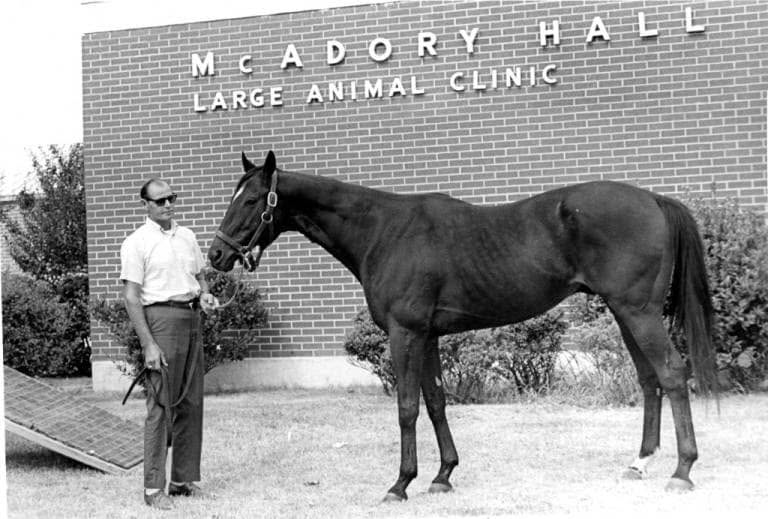
Shown in front of McAdory Hall in 1970, Bold Ruler was the world’s leading thoroughbred sire in the 1960s. Bold Ruler was brought to Auburn for cobalt treatment of a malignant tumor. The treatment enabled Bold Ruler to sire 29 more foals before his death. His offspring, which included 1973 Tripe Crown winner Secretariat, won more than 800 races and $13 million. One of his great-grandsons, Seattle Slew, won the Triple Crown in 1977.
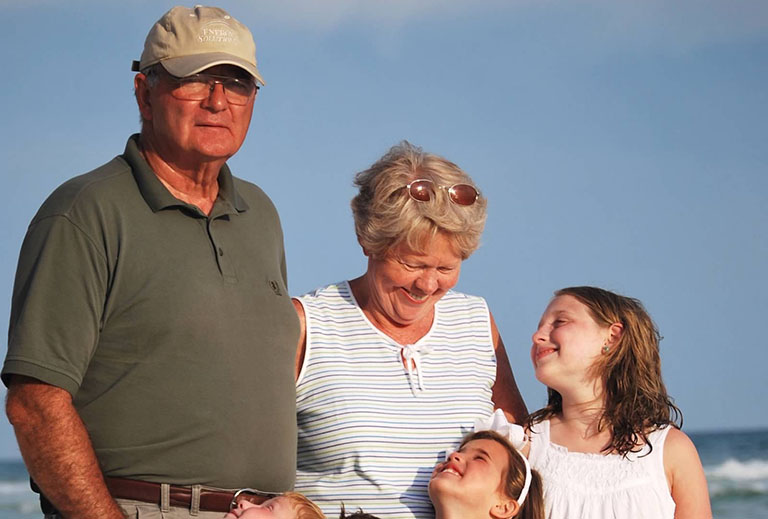
Smith’s grandfather, Kirksey Whatley (top left), served as the inspiration for her award-winning essay. As director of the Alabama Department of Public Health’s Office of Radiation Control, Whatley was on site at Auburn for the College Vet Med’s installation and calibration of the new cobalt-60 unit used to treat Bold Ruler. Photo credit: Contributed by Carrie Elaine Smith
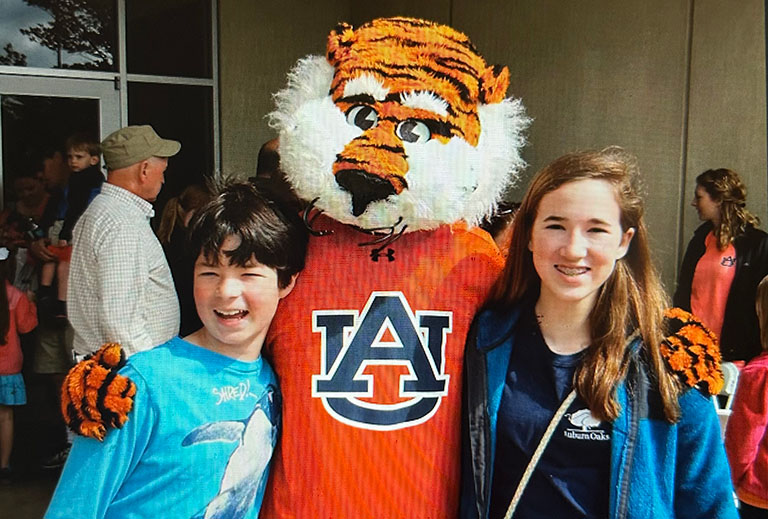
Becoming an Auburn DVM student marks a full-circle journey for Carrie Elaine Smith (right), pictured at the college’s annual Vet Fest event in seventh grade. Photo credit: Contributed by Carrie Elaine Smith
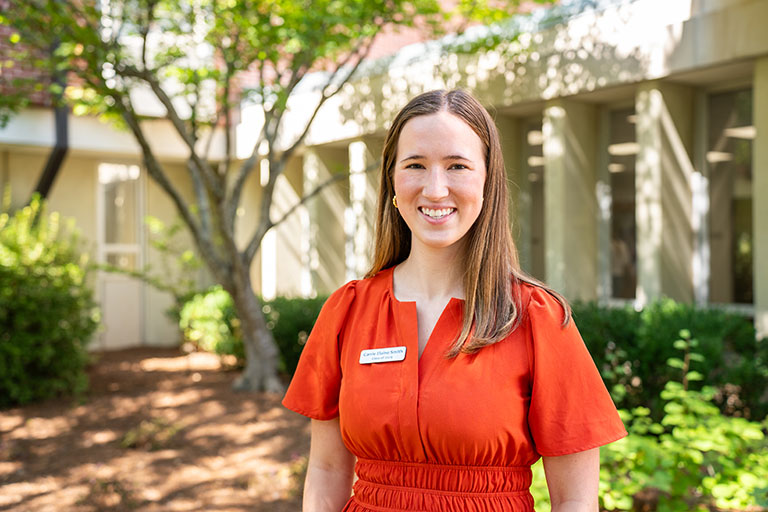
Class of 2029 student Carrie Elaine Smith recently earned fourth place in the American Veterinary Medical History Society’s Smithcors Student Veterinary History Essay Contest for a piece on Auburn Vet Med’s care of champion Thoroughbred Bold Ruler in 1970.
From Vet Fest to veterinary student
For Smith, the process of crafting a prize-winning essay tracked with her journey as an Auburn DVM student. Students are encouraged to follow their curiosity. In Smith’s case, childhood visits to the college’s Vet Fest event led to pursuit of a bachelor’s degree in microbiology from Auburn and work experience as a veterinary assistant for clinics in her hometown.
“I still have my shirt from my first Vet Fest in seventh grade,” Smith said. “There’s crinkles on the image from how often I’ve worn it.”
Since arriving at Auburn, Smith said she has been pleasantly surprised by how much she has enjoyed working with cattle, which she had lacked experience with previously. She volunteers with the Auburn University Raptor Center and has also explored aquatic animal medicine.
“I really enjoy general practice and building relationships with people while taking care of their animals,” she said. “Auburn’s vet school makes it very evident that there are so many different paths to take and that this is just a starting point and not necessarily the finish line. We’re always going to be learning.”
Sometimes, that learning process includes revisiting history. And ensuring important stories, like her grandfather’s, aren’t forgotten.
Students